How a lifelong connection with nature evolved into a creative platform for environmental awareness and action
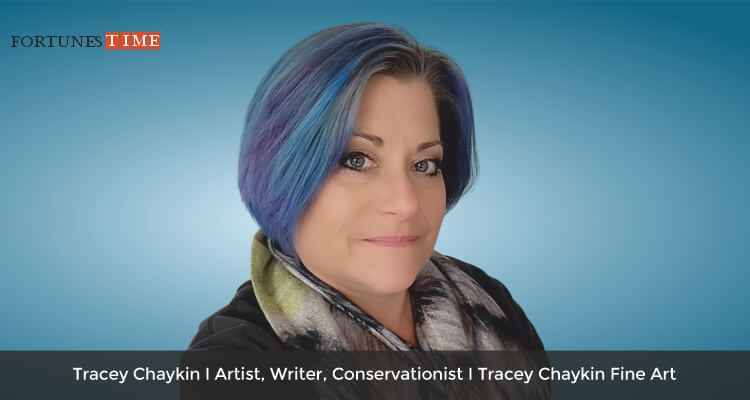
For Tracey Chaykin, art has never been simply about creating something beautiful. It is about noticing the world closely enough to care about it – and then finding meaningful ways to encourage others to do the same. As an artist, writer, and conservationist, Tracey has developed a body of work that exists at the intersection of creativity, environmental awareness, and advocacy. Through highly detailed colored-pencil and mixed-media artwork, she captures wildlife, plants, and the natural world with remarkable attention to texture, expression, and detail. Through writing and environmental advocacy, she explores the challenges facing the planet, while through conservation and humanitarian initiatives, she works to turn awareness into action. Tracey describes her evolving mission simply as “art, articles, and actions.” The phrase captures the philosophy behind her work: art can create an emotional connection, writing can deepen understanding, and action can transform that understanding into meaningful change. “I wasn’t simply drawing what I loved – I was drawing what I wanted to help protect,” Tracey explains. That realization fundamentally changed the direction of her creative journey. She does not expect a single drawing or article to change the world. Instead, Tracey believes meaningful change can begin with something much smaller: a moment of curiosity, a new understanding, or one different choice. “If it makes someone stop, become curious, learn something, or make one different choice, that’s where change begins.”
A Creative Spirit Rediscovered
Creativity has been part of Tracey’s life for as long as she can remember, although becoming a professional artist was certainly not part of her original plan. She grew up surrounded by creative influences. Her mother studied fashion design and oil painting, while her father was a talented carpenter. Tracey loved coloring as a child, and one early memory captures both her enthusiasm and her sense of humor. When she was about six, she and her younger sister decided that an unfinished wall unit their father was building needed their artistic assistance. They covered its lower panels with crayons. Her father, understandably, did not share their artistic vision. The girls were handed sandpaper and spent the day attempting to remove their masterpiece. Even the belt sander could not completely erase the evidence. Tracey now jokes that it may have been her first permanent installation.
Beneath the humor, however, was a deeper connection to creativity and nature that remained with Tracey. During an unstable childhood, art and the natural world became sources of happiness, peace, and refuge. As adulthood arrived, however, practicality took precedence. Tracey built a career, raised a family, and followed a conventional path. Art became something she had once loved rather than something she imagined could become a profession. Then, decades later, the adult coloring-book movement unexpectedly brought colored pencils back into her life. In 2016, Tracey challenged herself to create an original drawing and eventually entered it into a competition. The work received an Award of Merit and a publishing award before becoming her first sold artwork. Her reaction was one of surprise as much as excitement: Maybe I can actually do this. That moment marked the beginning of a new chapter. Tracey’s journey is one reason the idea that it is never too late to pursue a dream has become so important to her. She did not follow a conventional path into professional art. Instead, she found her way back to something that had been part of her all along.
Realism as a Path to Connection
Tracey’s artistic style is primarily hyper-realistic, with colored pencil as her principal medium. Her work is defined by meticulous attention to detail, whether she is capturing the texture of fur, the reflection in an animal’s eye, individual feathers, or the intricate structures of a flower. Colored pencil is particularly suited to her philosophy because it demands patience. Her drawings develop through layer after layer, requiring careful observation and an extraordinary degree of concentration. For Tracey, that process mirrors the way she experiences nature itself. “The more closely you look, the more extraordinary it becomes.” Yet technical realism is not her ultimate objective. Connection is. Tracey believes that when people truly see something, they begin to appreciate it. When appreciation develops, caring often follows. That philosophy is especially important when her subjects are wildlife and threatened ecosystems. Rather than using her art to lecture viewers, Tracey prefers to invite them closer. She wants people to pause, look carefully, become curious, and perhaps begin asking questions. Her work therefore operates on two levels: visually, it celebrates the beauty of the natural world, while conceptually, it encourages viewers to consider what is at stake when that world is threatened.
Inspired by Wonder
The simplest way Tracey describes the source of her creative inspiration is one word: wonder. An animal’s expression, a bee resting on a flower, an otter swimming offshore, milkweed growing in her garden, or sunlight transforming an ordinary landscape can all become the beginning of an artistic idea. She regularly photographs the world around her and finds herself thinking about which moments might eventually become drawings. Many of Tracey’s works are rooted in places she has visited or moments she has personally experienced. Morning Swim, for example, emerged from photographs of mallards at a local pond. Other works have developed from wildlife encounters, gardening, conservation projects, and causes that have captured her attention. Sometimes the inspiration is simply beauty. At other times, learning more about an animal, species, or ecosystem gives the subject a deeper significance. That distinction often determines which ideas remain passing observations and which become finished works. When beauty and meaning come together, Tracey knows she has found something worth creating.
From Beautiful Images to Meaningful Action
Nature is not simply a subject Tracey visits and then returns home to draw. It is an integral part of how she lives. She maintains an organic garden, plants for pollinators, collects rainwater, grows food for her family, and continually considers practical ways to live more sustainably. She readily acknowledges that she is not perfect, but believes that thoughtful choices matter. As Tracey learned more about climate change, habitat loss, plastic pollution, water issues, and declining wildlife populations, she began to feel that creating beautiful images alone was not enough. She wanted the work to do something. That realization expanded her role beyond the studio. Writing and advocacy became natural extensions of her artistic practice. She writes about environmental and climate issues, volunteers with The Climate Reality Project, participates in conservation and humanitarian initiatives, and looks for opportunities where creativity can support larger causes. Her philosophy can be summarized through a simple progression: art creates emotional connection, writing provides information, and action gives people somewhere to go with both. “I don’t believe everybody has to do everything. I believe everybody can do something.” That belief has become central to Tracey’s environmental message.
The Patience Behind the Pencil
For Tracey, the creative process begins long before the first pencil touches paper. A photograph, an animal, a conservation story, or simply a feeling can trigger an idea. From there, she researches her subject, considers composition, and thinks about what she wants viewers to experience when they encounter the finished work. Once the drawing begins, the pace changes completely. Colored-pencil artwork develops through numerous layers. Hours may be spent refining a relatively small section, adjusting color, temperature, texture, and value until the subject begins to emerge with greater realism. Eventually, Tracey reaches a moment she particularly enjoys: the point at which the animal or subject seems to look back at her. That is when she knows the piece is working. There is also an amusing contradiction in the process. Tracey describes herself as energetic in everyday life, making the ability to sit still for hours one of the unexpected gifts of creating art. Then comes the final challenge: deciding when the work is actually finished. Like many artists, she knows how tempting it can be to make “one last improvement” – even when that improvement is not necessary.
Learning to Get Out of Her Own Way
One of Tracey’s greatest challenges has not been technical. It has been learning to overcome the internal limitations created by years of believing that creativity was impractical. For much of her life, she carried the idea that dreaming was acceptable as long as one eventually returned to reality. Beginning an art career later in life required Tracey to confront those assumptions as well as her own insecurities. Her childhood experiences had taught her resilience, but they had also contributed to a tendency to question herself. Over time, however, she discovered that some of life’s most significant opportunities arrive before we feel ready for them. The Art Titans documentary became a powerful example. When Tracey was invited to spend four days being filmed and discussing her life and work, her immediate reaction was not simply excitement. She wondered whether the invitation could really be intended for her. She decided to say yes. The experience reinforced a lesson that continues to influence her: sometimes accepting an opportunity does more than change how other people see us. It changes how we see ourselves. For Tracey, saying yes became another form of creative courage.
Values That Keep the Work Grounded
Integrity, curiosity, compassion, responsibility, and hope form the foundation of Tracey’s creative and professional philosophy. She believes that environmental advocacy must begin with personal responsibility. If she speaks about sustainability, she believes she should examine her own choices. If she creates artwork featuring wildlife, she believes she should care about the ecosystems that allow those species to survive. And if she encourages others to make changes, she wants to remain willing to make changes herself. Hope is equally important. Environmental challenges can be so enormous that people become overwhelmed and conclude that their individual choices cannot possibly matter. Tracey wants her work to create the opposite response. Perfection is not the goal. Participation is. Individuals do not need to solve every environmental problem. They can begin by recognizing that their choices have value and taking one meaningful step. For Tracey, that mindset transforms environmental responsibility from an impossible burden into an invitation to participate.
Recognition with a Deeper Meaning
Tracey has experienced a number of significant milestones throughout her artistic career. Being recognized multiple times among the Top 60 Masters has been an honor, while becoming the inaugural recipient of ArtTour International’s Green Visionary Award was particularly meaningful because it acknowledged both her artwork and the environmental values behind it. Her story was also documented through Tracey Chaykin: Drawing the Pulse of the Living World, an experience she could hardly have imagined when she first returned to colored pencils. Yet one of the most meaningful moments in her journey was not an award or exhibition. It came through her daughter.
During the documentary, Tracey’s daughter was interviewed separately. Tracey did not know what she had said until she watched the completed film. Her daughter spoke about her mother’s artwork and message and expressed the hope that the work could reach people and make a difference, even if it ultimately influenced just one person. The moment affected Tracey deeply. As a parent, she had always hoped her children would listen to what she said. But she realized that perhaps even more important was what they learned from watching what she did. The experience caused her to think differently about legacy. Awards, exhibitions, and artworks are meaningful, but the values we inspire in other people may ultimately be the most enduring contribution.
The Artist’s Role in Environmental Awareness
Tracey believes artists have a unique ability to make people feel something before asking them to understand it. Scientific facts and environmental data are essential, but those subjects can sometimes feel distant or overwhelming. Art offers another entry point. A viewer may first be drawn to the eyes of an animal, the colors of a butterfly, or the beauty of a landscape. Then they may discover that the species is threatened or that its habitat is disappearing. Suddenly, an abstract environmental issue becomes personal. That is where Tracey sees the power of art. Artists do not always need to shout. Sometimes they simply need to make people pause. And a pause can become the beginning of a conversation.
Building a Platform for Creative Environmental Advocacy
Looking toward the next three to five years, Tracey sees the different strands of her work becoming increasingly interconnected. She plans to continue creating bodies of work focused on wildlife, threatened species, and ecosystems while expanding her environmental writing and conservation advocacy. She also hopes to develop additional humanitarian and conservation-focused art projects and collaborate with organizations where her creative work can support a broader mission. Her experience with documentary filmmaking also expanded her understanding of storytelling. Seeing art, landscape, conversation, family, conservation, and film brought together showed Tracey that her work does not need to exist within a single format.
As a result, Tracey does not necessarily envision Tracey Chaykin Fine Art simply becoming a larger art business. Instead, she sees it evolving into a broader platform for creative environmental advocacy. Art can create connection, writing can build understanding, and projects and partnerships can turn that understanding into action. The exact shape of that future remains open, and Tracey is comfortable with that uncertainty. Her journey has taught her that life can take unexpected turns – and that some of the most meaningful chapters are the ones we could never have predicted.
A Different Definition of Success
Success has also evolved for Tracey. Awards, exhibitions, publications, and recognition remain meaningful, and she is genuinely grateful whenever her work reaches a new audience. But increasingly, she measures success by what happens after someone encounters her work. Did an artwork make someone stop and really look at an animal they might otherwise have overlooked? Did an article teach someone something new? Did a conversation lead to one different choice? Did something she created remind someone that the planet is worth protecting? If the answer is yes, she considers that success.
Tracey’s own story carries another message: it is never too late to discover what you are capable of becoming. For years, she believed the practical life and the creative life had to remain separate. Eventually, she realized that purpose does not always arrive as a sudden revelation. Sometimes it grows quietly while we are busy living, until one day we finally recognize it. Her environmental message is similarly accessible. Making a difference does not require fame, power, perfection, or having every answer. Climate change, habitat loss, and conservation are enormous challenges, but meaningful change can begin when individuals decide that something matters enough to act. One artwork can start a conversation, one conversation can inspire an action, and one action can ripple outward farther than we may ever know.
Every drawing Tracey creates begins with wonder. Every conversation she has about conservation begins with hope. Perhaps meaningful change can begin just as simply:
Notice. Care. Act.
Connect with Tracey Chaykin Fine Art on Facebook, Twitter (X), LinkedIn, and Instagram.