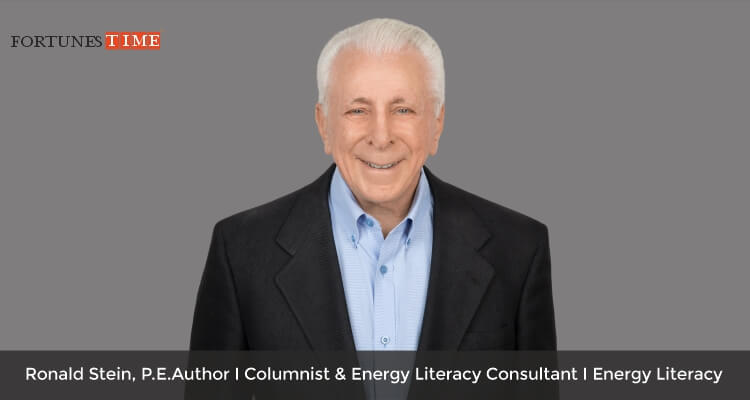
Ronald Stein, P.E., Author, Columnist & Energy Literacy Consultant at Energy Literacy, has made it his mission to encourage a more comprehensive understanding of the systems that support modern civilization. In an era when the word “energy” appears constantly in political, economic, and environmental discussions, Ronald believes that one of the greatest challenges is understanding what the term “energy” actually encompasses.
For Ronald, professional and personal success means helping policymakers and the public develop a clearer understanding of three distinct areas covered by the one all-inclusive word “energy”: transportation fuels, petroleum-derived products, and electricity generation. Each plays a different role in our modern life and economy, and understanding their relationship is essential to having informed conversations about the future.
His work is driven by a fundamental belief that society cannot make responsible decisions about tomorrow without first understanding the systems that made today’s world possible.
From Engineering the Energy Infrastructure to Explaining It
Ronald’s professional journey began with two of the world’s leading engineering organizations, Fluor and Bechtel, where he contributed to refinery design and construction projects across several regions of the world. Ron is an engineer, energy consultant, author, and founder of PTS Advance, a staffing agency for the energy sector, that grew from a startup to the largest such firm in the USA before being acquired by a firm in the UK.
Those engineering experiences placed Ronald at the center of one of the most sophisticated industrial processes ever developed: transforming raw crude oil into transportation fuels and petrochemical feedstocks. Working on major refinery projects required far more than technical engineering knowledge. Each facility involved numerous engineering disciplines, operational planning, safety standards, environmental considerations, logistics, and thousands of interconnected components.
Those engineering experiences taught Ronald to view energy as part of an integrated industrial system rather than as an isolated commodity.
His perspective was further shaped by observing what happens after crude oil is extracted. Through refining and processing, hydrocarbons become transportation fuels and feedstocks that ultimately contribute to an enormous range of products used throughout modern societies and economies.
“The world often focuses on crude oil itself, yet its true value lies in what human ingenuity has learned to create FROM it.”
That distinction remains central to Ronald’s energy literacy work today.
Rather than viewing crude oil solely through the lens of just oil, Ronald emphasizes its broader role in manufacturing and industrial supply chains. From transportation fuels to materials used in healthcare, communications, construction, electronics, sanitation, and manufacturing, he believes the public conversation needs to recognize the full scope of petroleum’s industrial applications.
Defining What “Energy” Really Means
One of Ronald’s primary objectives is to encourage greater precision in discussions surrounding the word “energy.”
In Ronald’s view, three different subjects are frequently grouped together under one term.
The first is transportation fuels required by airplanes, trucks, merchant ships, cruise ships, construction equipment, automobiles, and other forms of transportation.
The second is the more than 6,000 products and materials that Ronald associates with petrochemical feedstocks derived from crude oil. These include materials and components used throughout hospitals, communications, electronics, construction, sanitation, aviation, manufacturing, and countless other industries.
The third is electricity generation, which can involve nuclear, natural gas, coal, hydroelectric, wind, and solar technologies.
For Ronald, these categories are interconnected but not interchangeable.
Electricity can power a smartphone, computer, or medical device, but the electricity itself does not manufacture those products. Similarly, wind and solar technologies can generate electricity, but they do not directly produce transportation fuels such as jet fuel, diesel, or gasoline.
Worldwide economies run on transportation fuels.
- Jet fuel to support military and commercial airplanes, as at any given peak moment, there are typically between 12,000 and 20,000 planes in the air worldwide,
- Diesel fuel to support trucks and construction equipment of which hundreds of millions are commercial and light-duty trucks
- Gasoline to support roughly 1.7 billion total motor vehicles in the world
- Bunker fuel for around 116,000 commercial ships globally, trading across the globe and carrying 90 per cent of all goods and commodities
Wind turbines and solar panels can ONLY generate electricity, under favorable weather conditions but CANNOT make any of the products or transportation fuels MADE FROM oil.
Zero Green Energy Ideologists are OBLIVIOUS to reality the “Energy Transition” is only an “Electricity Transition”.
- They demand that we shut down the energy and economic systems that make our lives, health and living standards possible, because they insist on forcing us to eliminate those that work – and replace them with just electricity generated by favorable weather conditions that bring blackouts, poverty, disease, deprivation, joblessness and shortened lives!
- They tell the poorest people on Earth that they must renounce their God-given right to modern technologies, health and living standards – and sacrifice their landscapes and wildlife with wind turbines, solar panels and occasionally generated electricity trash on their altar of climate fanaticism?
The limitations of wind turbines and solar panels forms the foundation of Ronald’s approach to energy literacy.
- Wind Turbines and Solar Panels CANNOT produce the transportation fuels required by airplanes, trucks, merchant ships, cruise ships, construction equipment, and vehicles.
- Wind Turbines and Solar Panels CANNOT make any of the more than 6,000 products made from fossil fuels for today’s materialistic society and economies around the world.
- Wind Turbines and Solar Panels ONLY generate electricity under favorable weather conditions.
He believes policymakers must understand not only how electricity is generated, but also how the fuels, materials, equipment, and infrastructure required by modern civilization are produced.
The Industrial Backbone Behind Everyday Life
Modern consumers rarely think about the industrial systems behind the objects they use every day.
A smartphone requires sophisticated materials and manufacturing processes. A hospital depends on medical equipment, pharmaceuticals, plastics, chemicals, transportation, and reliable infrastructure. An aircraft requires specialized materials, manufacturing, transportation fuels, and an enormous global supply chain.
For Ronald, these are not disconnected examples. They represent an interconnected industrial ecosystem.
Over the past two centuries, advances in refining, manufacturing, engineering, transportation, and industrial technology have helped transform societies around the world. During the same broad period, global population grew from roughly one billion people to more than eight billion. Alongside that growth came extraordinary improvements in food production, healthcare, transportation, communications, sanitation, manufacturing, and living standards. Ronald believes that this extraordinary transformation cannot be fully understood without examining the industrial systems that supported it.
His message is therefore broader than a debate about individual energy technologies. He wants people to understand the complete chain – from raw materials and refining to manufacturing, transportation, infrastructure, and consumption.
Challenging Simplified Energy Narratives
As an author, columnist, and energy literacy consultant, Ronald frequently challenges what he considers overly simplified narratives surrounding the transition away from fossil fuels.
His central argument is that wind and solar should be evaluated according to what they actually provide: only electricity generation from favourable weather conditions.
He points out that transportation systems require fuels with specific characteristics and that modern manufacturing requires chemical feedstocks and materials that electricity alone does not automatically provide.
Aircraft, ships, trucks, automobiles, and construction equipment all have different operational requirements. Likewise, industries such as healthcare, agriculture, electronics, construction, and communications depend upon complex supply chains of the products made from the oil derivatives extracted from raw crude oil.
Ronald therefore asks a broader question: if society intends to reduce or eliminate fossil fuels, how will it replace not only their role in electricity generation but also their role in transportation fuels and industrial feedstocks?
For him, that question deserves as much attention as the discussion surrounding electricity generation.
Why Energy Literacy Matters to Policymakers
Ronald believes one of the biggest challenges facing today’s policymakers is the tendency to discuss energy without examining its different applications.
He argues that policymakers need to recognize the distinction between generating electricity and manufacturing the products and fuels that modern civilization requires.
His concern is that policy decisions made without understanding those distinctions could create unintended consequences for transportation, manufacturing, agriculture, healthcare, defense, and global commerce.
That is why Ronald advocates for what he calls energy literacy – a deeper understanding of how the world’s energy and industrial systems actually function.
His objective is not simply to provide information, but to stimulate meaningful conversations about the consequences of energy decisions.
The Challenge of Communicating an Uncomfortable Message
One of Ronald’s greatest challenges is communicating a message that can conflict with popular assumptions.
The modern energy debate is often presented as a straightforward transition from fossil fuels toward so-called renewable electricity. Ronald believes the reality is considerably more complicated because fossil fuels serve multiple purposes beyond electricity generation.
Transportation fuels are essential to aviation, trucking, shipping, construction, and other industries. Petroleum-derived materials are incorporated into countless products. Electricity generation represents a distinct component of the energy system.
Explaining these differences to policymakers and the public requires persistence.
Ronald has responded by taking his message beyond traditional engineering environments and into public commentary, writing, and education. Through his books and weekly articles, he seeks to make complex industrial relationships understandable to a wider audience.
For him, energy literacy begins by asking basic questions that are sometimes overlooked.
What exactly does society need from its energy system? Which technologies can provide those functions? What materials are required to manufacture the infrastructure? What fuels are needed for transportation? And what happens to global supply chains when one component of the system changes? These questions form the foundation of his energy literacy work.
A Columnist With a Clear Mission
As a columnist for America Out Loud News, Ronald uses his writing to emphasize what he considers the overlooked dimensions of the energy debate.
His columns repeatedly return to the relationship between hydrocarbons, transportation, manufacturing, and modern infrastructure.
He argues that wind and solar can generate electricity but cannot independently provide the entire range of transportation fuels and industrial materials required by modern civilization.
His writings are intentionally direct because he believes energy discussions have become too narrowly focused on electricity.
For Ronald, meaningful energy policy must consider the entire industrial ecosystem and economy.
That means examining the needs of commercial aviation, military aviation, international shipping, trucking, construction, manufacturing, healthcare, agriculture, communications, and infrastructure – not simply the source of electricity delivered to a power grid.
Leadership Through Knowledge and Persistence
Ronald believes leadership requires more than accepting conventional thinking. It requires the willingness to examine assumptions, understand consequences, and communicate difficult realities.
He is particularly critical of what he sees as insufficient understanding among policymakers regarding the relationship between crude oil, electricity generation, manufacturing, and transportation.
His own approach to leadership has been shaped by decades of engineering experience and continued learning, inclusive of being the Project Manager for the JAWS attraction that was part of the Universal Studios first theme park in Florida.
Rather than presenting himself as someone who has finished learning, Ronald believes professional growth requires continuously examining new information and challenging existing assumptions.
That philosophy has carried him from engineering projects to writing and public education.
Today, his leadership takes the form of communication: using his experience to encourage people to ask better questions about one of the most consequential subjects facing the global economy.
The Human Dimension of Energy Policy
Behind Ronald’s technical arguments is a broader concern about people and the quality of life that modern infrastructure supports.
Energy systems are ultimately connected to healthcare, food production, transportation, communications, housing, employment, and economic opportunity.
When an energy system changes, the effects can extend far beyond power generation.
Ronald therefore believes that policymakers must consider the human consequences of energy decisions alongside environmental and technological objectives.
For him, energy literacy means understanding those connections before policies are implemented.
The goal is not simply to determine which technologies should grow, but to understand how every component of modern society will continue functioning throughout the transition.
Looking Toward the Future
Over the next three to five years, Ronald intends to expand the reach of Energy Literacy through continued writing, books, columns, and public discussion.
His goal is to stimulate conversations that begin with a comprehensive understanding of today’s industrial reality.
He wants readers and policymakers to consider the transportation fuels required by commercial and military aviation, trucking, shipping, construction, and automobiles. He also wants greater attention given to the petroleum-derived feedstocks incorporated into thousands of products used throughout modern life.
At the same time, he believes electricity generation must remain an important part of the conversation but as one component of a much larger system.
For Ronald, the future of energy policy should therefore be based on a complete assessment of society’s needs rather than on a single technology or energy source.
Creating a More Informed Energy Conversation
Ronald Stein’s work ultimately revolves around one objective: making energy literacy a prerequisite for energy policy.
His decades of experience in engineering and refinery projects gave him firsthand knowledge of the complexity behind modern energy infrastructure. His work as an author and columnist has allowed him to transform that experience into a broader public conversation.
Whether discussing transportation fuels, petrochemical products, electricity generation, manufacturing, or global supply chains, Ronald consistently returns to the importance of understanding how the pieces fit together.
He believes society has an obligation to ask difficult questions before making decisions that affect billions of people.
The energy conversation, in his view, should not begin with the question of which technology should win.
It should begin with understanding what modern civilization actually requires and determining how those requirements can realistically, reliably, and responsibly be met.
That is the purpose behind Ronald’s continuing work in energy literacy: to replace assumptions with understanding, simplify complexity without ignoring reality, and encourage policymakers to look beyond the word “energy” to the intricate systems hidden behind it.